Reliable Digital Signage Without Internet in India
A practical approach to building low-dependency display systems
In many parts of India, stable internet is still inconsistent, especially in retail, healthcare, and industrial environments. Despite this, businesses increasingly need dynamic and modern communication tools. Offline digital signage solves this by removing dependency on constant connectivity while ensuring consistent content delivery. It is reliable, cost-efficient, and easy to manage. This guide outlines a practical approach to setting up offline digital signage for Indian use cases.
Written by
Sidharth Gaikwad
Read Time
2 minutes
Posted on
03/19/2026

What Is Offline Digital Signage?
Offline digital signage refers to display systems where content is stored locally on the device and played in a loop or scheduled format without requiring an active internet connection. A typical setup includes a display screen, a media player such as a USB-enabled system or Android box, and preloaded content like videos or images.
This approach ensures uninterrupted playback, making it especially useful in environments where network reliability cannot be guaranteed.
Why Offline Signage Works Well in India
Offline signage aligns closely with the realities of Indian business infrastructure, where internet reliability and cost can vary significantly across locations. By removing dependency on connectivity, businesses can maintain consistent communication without interruptions.
In addition to reliability, offline systems are cost-efficient, easy to deploy, and require minimal technical expertise, making them suitable for both small businesses and large distributed networks.
Key Use Cases in India
Offline digital signage is widely adopted across multiple sectors due to its simplicity and reliability.
Retail stores use it to display promotions and pricing, clinics and hospitals rely on it for patient communication, manufacturing units deploy it for safety and operational messaging, and educational institutions use it for announcements and schedules.
How to Set Up Offline Digital Signage
1. Choose the Display
Start by selecting a suitable LED or LCD screen with USB playback support, ensuring it meets your requirements for size, brightness, and long-duration usage.
2. Select a Media Player
Depending on the level of control needed, you can use a basic USB or SD card setup, an Android media player for flexibility, or a mini PC for more advanced configurations.
3. Prepare Content
Content should be optimized for resolution, file size, and format, typically using MP4 for videos and JPG or PNG for images, while keeping messaging clear and visually effective.
4. Load Content Locally
Transfer the content to the device using USB, SD card, or internal storage, and configure the system to automatically play content on startup.
5. Set Playback
Most systems allow content to be looped continuously or scheduled based on time, enabling basic content management without requiring internet access.
6. Plan Content Updates
Since updates are not remote, businesses should define a structured process that includes regular refresh cycles, standardized content files, and on-site execution.
Scaling Offline Digital Signage
Scaling offline signage requires a structured approach, including standardized templates, centralized content creation, and batch distribution of updates across locations. Some businesses also adopt a hybrid model, combining offline playback with periodic internet syncing to improve efficiency.
Challenges to Consider
While offline signage is reliable, it introduces certain operational limitations. Content updates require manual effort, managing multiple locations can become time-consuming, and the lack of real-time control makes it difficult to respond quickly to urgent communication needs.
Best Practices
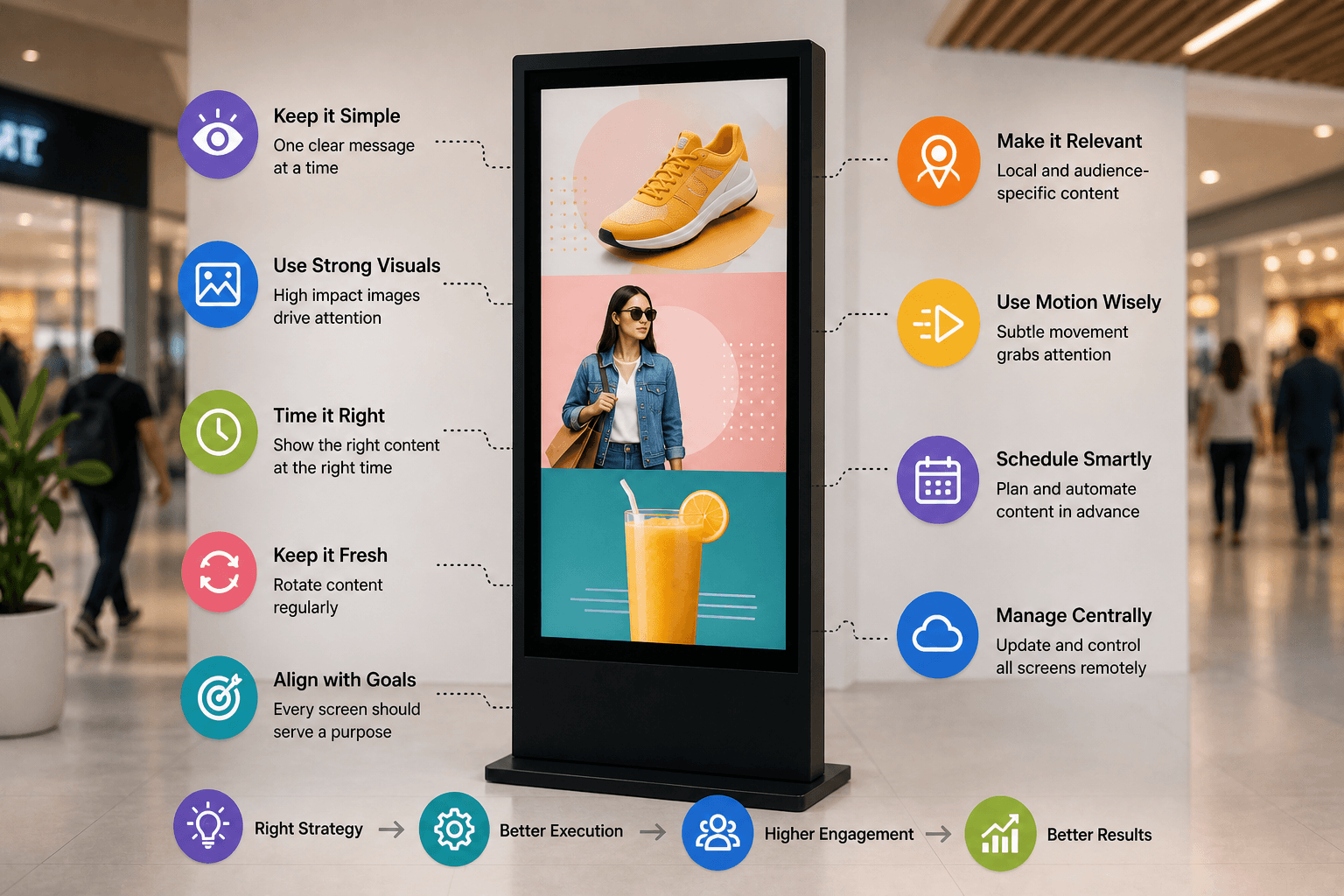
To maximize effectiveness, businesses should focus on keeping content simple and readable, standardizing formats, training staff for basic operations, maintaining backup files, and planning updates in advance to avoid inconsistencies.
Conclusion
Offline digital signage is a practical and dependable solution for businesses operating in environments with limited or unreliable internet connectivity. It ensures consistent communication while reducing operational costs and technical complexity.
However, it comes with trade-offs in flexibility and scalability, making it important for businesses to evaluate their long-term needs. In many cases, a hybrid approach that combines offline reliability with selective connectivity offers the best balance.
For organizations looking to implement or scale digital signage systems, Flickerwall provides the infrastructure needed to build efficient, scalable, and future-ready display networks.